aikyam fund - Making resilience accessible to early stage NGOs & ideas for social Impact
Making resilience accessible to early stage NGOs (< 5 years) & ideas for social Impact
Abundance of good people doing great work...
- Right to information(RTI), Forest Rights Act, Protection of Children from sexual Offences Act, Juvenile Justice Act, Right to Education, Digital Personal Protection Act, 2023(DPDP Act) are a reality because of Civil Society efforts in India
- Indians are giving more. Private philanthropy at 1.3 lakh crore in FY24 (1.05 lakh crore in FY22)
- More Students preparing to work in the Social Sector through universities like APU, TISS, APUs, etc)
Scarcity of Resilience: Everyone celebrates when NGOs create impact. No one tracks when they quietly disappear later.
- Only 4.1L active NGOs (July 2025) are listed on DARPAN. The ratio of NGOs to citizens is approximately 28 NGOs per 1L citizens, compared to 186 in Brazil, 64 in China, and 200 in Russia.
- Its estimated that number of fundable effective (>1 Cr/year) organisations in India could be less than 4000.
- 6/10 early-stage NGOs do not get funding due to challenges with capacity around compliances, outreach.
- 3/10 mid sized NGOs do not get repeat funding from trusts and foundations due to capacity and systems around compliance challenges, program delivery and monitoring frameworks.
- 5/10 NGOs (all sizes, stages) have less than 3-month cash runway.
- 8/10 NGOs (all sizes, stages) struggle to obtain indirect costs funding (capacity building, technology, operational infrastructure, team building) leading to organisation stunting
What do we mean by 'resilience'?
A resilient NGO is one that survives disruptions and keeps serving the vulnerable communities they work with.
Let's imagine two NGOs lose their main funding.
- The non-resilient one closes in 2-3 months - NGO can't pay rent, team quits, programs for vulnerable communities abandoned.
- The resilient one tap their other funding streams, use their 6-month cash reserve, team takes temporary pay cuts but stays because they trust leadership. programs for vulnerable communities continue.
Organizational challenges aren't isolated problems - they're symptoms of interconnected systemic gaps
We analyzed 50 NGOs that survived 5+ years versus 30 that shut down within 3 years. We learnt that organizational challenges aren't isolated problems - they're symptoms of interconnected systemic gaps. A compliance failure often stems from team capacity issues & rapidly changing regulations. Fundraising struggles connect to storytelling and program design gaps. Team burnout links to operational inefficiencies and unmet needs of team members.
4 Key interconnected components of Resilience stood out in the NGOs that are resilient:
- Compliant & Efficient Operations
- Psychologically Safe Workspaces, Teams
- Measurable, Impactful Programs
- Diverse, Predictable fundraising streams
There could be more components like Community trust, Government relationships, etc. We will continue to observe these with each cohort to refine.
Based on our work with around 100 Ideas/NGOs at various stages, we've identified distinct patterns in how organizations develop resilience capabilities. This pattern suggests that NGOs typically are good at program delivery and basic compliances but face challenges in impact frameworks, operational efficiency, organizational sustainability, Diversified fundraising and team wellness -areas critical for long-term resilience.
TEST: Tiny Experiments for Social Transformation as a way to finding practical solutions
Tiny Experiments for Social Transformation (TESTs) are small, manageable tests we run to explore ideas, learn quickly, and make better decisions. They involve trying out something new on a small scale, observing the results, and then deciding whether to pursue it further. It involves breaking down large goals into tiny, achievable steps, that add up in value over time for the end user.
We ran over 200 TESTs with partner NGOs to address resilience gaps. Listing a few key TESTs and the learnings that is helping us shape the program:
What can Leaders do for greater Team Alignment & shared vision?
- Challenge: Founder has clear vision & values statement but team doesn't know it. Everyone works hard but on different "vision" and believes in different values
- TEST: A workshop with all team members co-facilitated by the organisations leadership.
- Key Learnings: Workshops around Listening, Appreciative Inquiry, Shared Values, Imagine the Future on a regular basis in psychologically safe spaces helps towards mission aligned teams. Building capacity of the Leadership to do this regularly is crucial.
How can we make Regulatory compliances accessible to CSOs?
- Challenge: Imagine an Accountant in rural Karnataka who needs GST help. Tries Googling in Kannada - nothing. Googles in English - 40 confusing articles. Calls expensive consultant. Pays ₹3000 for a 10-minute answer that should be free
- TEST: An Free Online library of curated resources on Compliance accessible in 14 Indian Languages with AI podcasts
- Key Learnings: Finance teams from NGOs across India visit the platform regularly, Content is now more discoverable through Google Search, AI Searches. Content shared by different stakeholders freely to contribute. Resources are just a start. We need to work on better ways to hold space for them by doing regular webinars.
Why are NGOs afraid to ask for help?
- Challenge: Challenges around learning to ask for help among Civil Society Organisations team members.
- Test: Enabling discussions in an online forum for CSOs to ask questions. co created by aikyam, RNPF, Saathi
- Key Learnings: Questions through Email & Whatsapp easier to collect, Anonymous posting of Questions with Answers around sensitive topics helpful, Language Translate made discussions more accessible. NGOs were cautious to ask questions publicly as it might affect them. We need to work to solve for challenges faced by Users to "frame the question"
How can we make critical information (like laws) accessible to vulnerable groups?
- Challenge: New gig worker law has 15 protections. We tested 50 gig workers - zero knew about even one protection. Why? 30+page PDF in legal English & Kannada on government website.
- TEST: aikyam fellows did In person campaigns with gig workers in bangalore to share an Free Online Library of curated Acts with NotebookLM Video Audio summary and translations in 14 Indian Languages
- Key Learnings: Native Language Video Summaries uploaded on Youtube very helpful to gig workers, Stickers with QR Codes to access the accessible version of the Law. We did not think through Grievance Redressal workflows while spreading the word.
How can we make Storytelling tools & Frameworks effortless for CSOs so they can tell their stories better?
- Challenge: NGO A helped 1,000 children. Their website says 'We do education.' and a donate link that no one clicked. NGO B with 100 children raised ₹10L in crowdfunding with story of one girl, Priya, who became first doctor in her village.
- TEST: Training NGOs to craft & share Impact stories through hands on workshops
- Key Learnings: Tech is only 2% of the Website Problem, Tools made it easier for NGOs to tell their stories from the ground, Zero Cost through Volunteer support and Digital Ocean hosting donations for Non profits.
Is there value in creating an alliance of Finance Practitioners working together to create shared compliance resources for CSOs?
- Challenge: Critical Compliance Updates not reaching on-ground teams who find it difficult to monitor daily changing compliances and regulations
- TEST: an online community of finance practitioners members from across CSOs
- Key Learnings: 1800+ Active Members with 76% of them active in the last 30 days. Regular Emails, WhatsApp alerts on important changes. High open rates of above 50% on newsletters and a click rate of 12-14%. We need to improve to make it more community led and increase membership.
What are the barriers in nurturing talent for CSOs?
- Challenge: Great people want meaningful work but can't find social sector jobs. NGOs post "we need help" but dont get enough relevant applicants. Why? job descriptions lacking in detail, hidden on websites nobody visits.
- TEST: aikyam jobs - Hand curated jobs from social impact orgs with rich job descriptions to attract talent
- Key Learnings: SEO friendly content, Adding context about the organisation within the job description, clear salary ranges and an option for NGOs to track applications became valuable to NGOs and job applicants. We failed at building community of volunteers to add job posts, increase outreach to univeristy placement cells. We are working to improve this.
How can we create psychologically safe spaces for dialogue?
- Challenge: In a planning meeting of Organisation: 8 people, 1 talks (Founder), 7 silent. Asked privately later - all 7 had concerns about the plan. None spoke up. Plan failed in 3 months affecting vulnerable communities.
- TEST: We ran aikyam space a 12 bed stay and workshop space in Kochi and Carefully curated Workshops, bootcamps to bring together like minded folks from CSOs to solve urgent and important problems faced by the teams.
- Key Learnings: Increased sense of psychological safety, Felt safer to ask for help, Better mission aligned teams, Being away from the day to day field work for a few days in carefully curated workshops provided opportunities to reflect and course correct. The space and methods can be replicated within organisations.
How Failure to implement tech systems without underlying foundations around policies, SOPs affected both us and the NGO we worked with
- Challenge: A Tech System to manage & track all Operations within an NGO to improve compliance and efficiency
- TEST: Worked with an NGO to move them from paper based to ERPNext for their day to day operations.
- Key Learnings: We Failed and this affected the NGO and us. Policies needed to set up HR workflows were not ready, Employee data was not collated at one place, Leadership was not involved in the implementation and it was delegated. Program teams did not understand why this system was needed.
..and more TESTs.
This approach by running experiments on actual problems and creating live solutions with feedback helped us to create a first draft framework for solving this in a systematic way for our partner NGOs/Ideas/projects.
aikyam fund aspires to Make resilience accessible to early stage NGOs, ideas for social impact
Every year, We identify a cohort of early stage social impact Ideas, non profits & at risk non profits in India working on urgent and Important challenges affecting vulnerable communities and the planet.
This cohort goes through our 12-month program of Hands on Bootcamps, Workshops, Mentoring that treats organizations/Ideas as complex adaptive systems, addressing four interconnected components simultaneously:
- Compliant & Efficient Operations
- Psychologically Safe Workspaces & Teams
- Measurable, Impactful Programs
- Diverse, Predictable Fundraising Streams
To set them up for success, we came up with a progression framework that actually works

Image: From L1 to L4: Participating NGOs are able to unpack benefits at each level.
| Level > | L1 | L2 | L3 | L4 |
| Compliance & Operations |
Regulatory Foundations Complete
12A, 80G, DARPAN, Audits, Statutory Filings, Banking, PAN |
Core Policies Implemented
Team trained on HR, Procurement, Travel, Expense Claims policies. PoSH ICC Committee formed. Data Privacy, Financial Procedures manual and Monthly reporting |
Tech Systems Integrated
Accounting, Fit for purpose ERP, Compliance Calendars, Quarterly internal audits, SOPs for key processes |
Compliance & Efficiency Optimized
Zero compliance violations, tech systems and SOPs adoption rate >80%, cost per beneficiary optimized, Mentoring other CSOs |
| Psychologically Safe Workspaces, Teams |
Leadership framework Established
Vision, Mission, Values Statements, Board, Founding team roles, Hiring process, First hirings |
Team Development Active
Onboarding, induction process in place, Team Building and capacity building plans created and first sessions started |
Collaboration Systems ready
Communications platforms, project management tools, knowledge management tools, regular knowledge sharing sessions) |
Psychologically Safety achieved in Workspace
Team recommends org to others, <15% annual attrition, mental health support available to staff, Innovation time/support for new ideas by team, sharing best practices with others in the ecosystem |
| Measurable, Impactful Programs |
Program Design co-created with agency to communities they work with.
Identify stakeholders, their needs & vulnerabilities, barriers to those needs, solution, feedback loops. |
Community driven Monitoring System Operational
Program workflows mapped, output indicators tracked, outcome indicators defined with baseline, program review rhythm established with community |
Program Monitoring Active with monthly feedback from community
Mid course corrections, annual impact assessment, feedback loops with communities at risk |
Impactful Programs delivery demonstrated
Replicable program models that are recommended or adopted by others working on similar challenges, providing support to others replicating/improving the model |
| Diverse, Predictable fundraising streams |
Story & Impact Framework Ready
Why they exist, what they do, Theory of Change, 3-5 impact case studies, basic website, A basic clear communication deck/document |
Outreach Plan Active
Fundraising plan in place, Donor lists, engagements, key fundraising opportunities identified, 1-3 Funding proposals submitted, Individual Giving started with 30-50 regular givers |
Diverse streams of fundraising active
Individual giving CRM, 1-2 CSR/Trust Partnerships established, Grant Management systems, Active Website, Engagement with stakeholders through newsletters, events |
Financial Resilience Achieved
6+ months cash flow reserves, Revenue streams diversifed with no source more than 40% of total annual income, multi year grants secured (1-2), Individual Giving retention >60% |
We also support select Ideas, NGOs by covering costs (Around INR 10L) to implement recommendations during the above programme. (This could include cost of expert consultant on compliance, facilitation, logistics, Financial Support for Founders if no income source, etc). These costs are directly paid to the Service providers, consultants, interns and not to the NGO.
Our vision is to build alliances and shared infrastructure, resources that can benefit Civil Society as an Ecosystem
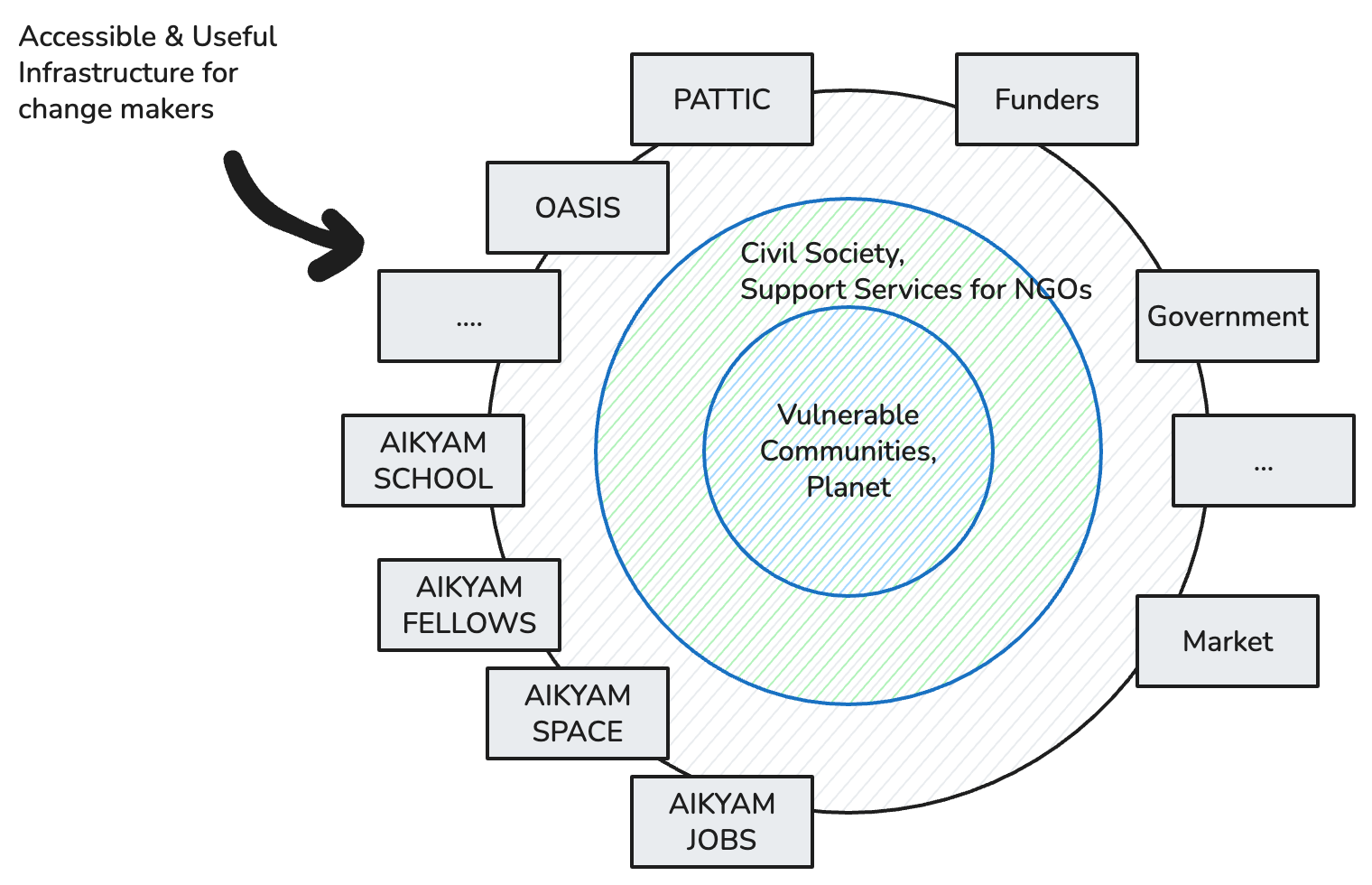
The Cohort approach helps us to understand the problems at a deep level. The knowledge from that is then channeled to nurturing/co-creating an eco-system of "infrastructure" for NGOs through public resources/projects/alliances like:
-
- aikyam space - Convening, Reflective spaces for NGOs in Fort Kochi Details 🔗
- aikyam jobs - Hand curated jobs in social impact Details 🔗
- aikyam fellows - Program, Design, Tech, Strategy support for NGOs Details 🔗
- Our Alliances:
- PATTIC - Community, resources for statutory & regulatory matters Details 🔗
- OASIS (Partner) - Making Open Source Software accessible to NGOs Details 🔗
Selection Criteria for NGOs/Ideas (Draft)
- Founder(s) should be working full time on the project/Idea
- Should be registered or in the process of being registered as a Not For Profit Entity in India
- Social Enterprises also encouraged to apply.
- Work should be in India
- We are currently focusing only on Non FCRA Entities.
References for Due Diligence, Impact Stories
- Nasmina of iLab India - Making resilience accessible to coastal communities through Education & Livelihood | info@ilabindia.org
- Rohit Sharma for Awaaz Leadership Labs | rohitsharma@nujs.edu
- Anjali from Thudippu - Vulnerable Art Forms should have an address | anjali.thudippu@gmail.com
- Pranav from OASIS - Making Free & Open Source Technology accessible for NGOs | pranav@oasishq.org
- Suresh Ponnappa from PATTIC - Community for statutory and regulatory matters for NPOs. suresh@rohininilekaniphilanthropies.org
- Roshni from Samagata Foundation. roshni@samagata.org
We are a team of practitioners who've made every mistake so our partners don't have to
Key team members
- Shemeer Babu is aikyam fellow and Co-founder providing leadership and implementation support to the team.
- Chhabil Gadia is Chief Finance Officer at aikyam. Experienced in
- Jinso Raj is aikyam fellow and helps make Free & open Source tech more accessible to CSOs.
- Pooja Thyagi is aikyam fellow and runs PATTIC that makes regulatory compliances more accessible to CSOs.
- Minah Jalal is aikyam fellow and runs aikyam space to make psychologically safe spaces accessible to change makers.
- Femina Fathima is aikyam fellow and helps make resilience more accessible to tiny enterprises through of digital and local commerce.
(Note: Alumni from our programs are valuable part of our extended team.)
We have raised INR 3.5 Cr out of INR 10.3 Cr needed to support 45-55 Ideas/NGOs in India in 3 Years while nurturing high quality infrastructure/resources for the Ecosystem
| S No | Description |
Y1 |
Y2 |
Y3 |
| 1 | People (Fellowships, Salaries, Consulting, Interns) | ₹67,20,000 | ₹69,88,800 | ₹72,68,352 |
| 2 | IT Infra for NGOs (Hosting, Laptops, Devices) | ₹17,50,000 | ₹18,20,000 | ₹18,92,800 |
| 3 | IT Consulting for NGOs (Customisations of FOSS) | ₹7,00,000 | ₹7,28,000 | ₹7,57,120 |
| 4 | Office/Space (Rent, Utilities, Medical, Facilities) | ₹28,00,000 | ₹29,12,000 | ₹30,28,480 |
| 5 | Space (Furniture, Fixtures, Maintenance) | ₹3,50,000 | ₹3,00,000 | ₹3,00,000 |
| 6 | Legal & Compliances | ₹2,50,000 | ₹2,60,000 | ₹2,70,400 |
| 7 | Total Aikyam Operating Costs (1 to 6) | ₹1,25,70,000 | ₹1,30,08,800 | ₹1,35,17,152 |
| 8 | Support for Ideas/NGOs 15 in Y1, 15 in Y2 & 20 in Y3 ~ 6.4 Cr INR for 3 years = Total 50 Ideas/NGOs | ₹1,82,20,000 | ₹1,89,48,800 | ₹2,67,58,784 |
Note:
- We have raised INR 3.56 Cr as of August 2025.
- Year on Year Inflation at 4%,
- aikyam operating costs are optimised/capped in Y1 and Y2 by leveraging on public infrastructure, support that we are a part of (like PATTIC, OASIS, etc) and support/mentoring by alumni as a way of paying it forward
What is INR 10L Support for Ideas/NGOs? (#8 in table above)
All NGOs, especially early stage need financial support (Expert advice, Travel, Administration, basic sustenance for founders, emergency funds) as they go through L0→L1→L2→L3→L4 progression framework - Not all NGOs will advance through every level - progression depends on organizational readiness, capacity, and specific needs. Some may graduate early, others require extended support at certain levels.
Investment for a cohort of 10 NGOs/Ideas : Atleast ₹1,08,20,000 for 1 year (average across varied NGO development stages).
High Level Financial Projection [Draft]
Grant Request of INR 3-5 Cr for 3 years from Trusts & Foundations in India
A total of INR 3-5 Cr in 3 tranches as a support/fund for around 25-45 NGOs/Ideas over 3 years (September 2025 - August 2028) while nurturing high quality infrastructure/resources for the Ecosystem
For any queries, interest in funding us, please write to shemeer@aikyamhq.com
Proudly Not for Profit
We're a Section 8 nonprofit.
Company Registration
- List of Directors.pdf
- AoA.pdf
- CERTIFICATE OF INCORPORATION T4G.PDF
- PAN_T4G.pdf
- License for Section 8 of Companies Act.PDF
- MoA.pdf
- Darpan_Registration.pdf
12A & 80G
CSR Registration
Audited Financials
- Audit Report & Financials_FY23.pdf
- Audit Report & Financials_FY24.Pdf
- Audit Report & Financials_FY25.pdf
Income Tax Returns
- FY 2022-23
- FY 2023-24
- FY 2024-25
Annual Reports
Policies